
Engineering
Specialist Diploma in Semiconductor Manufacturing
Open for Registration
Open for Registration
Course Type
Specialist Diplomas
Engineering
Electronics
The Specialist Diploma in Semiconductor Manufacturing aims to equip students with the skill sets to navigate the various aspects of IC manufacturing.
This course is open for registration. Apply here.
About course
Course overview
Electronics manufacturing is a major industry underpinning Singapore’s economic growth and is a crucial contributor to Singapore’s gross domestic product. To date, many multinational corporations in the semiconductor industry, including GlobalFoundries, Micron, Systems on Silicon Manufacturing Company, United Microelectronics Corporation, and Vanguard International Semiconductor Corporation, have set up their operations in Singapore, creating ample career opportunities within the sector.
The Specialist Diploma in Semiconductor Manufacturing aims to equip students with comprehensive knowledge and skills in the following core areas:
Integrated Circuit (IC) Design
Process integration
Product yield engineering
Quality assurance
IC packaging
Reliability and failure analysis
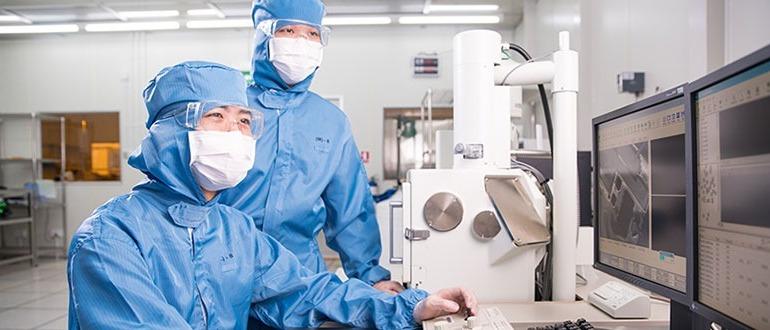
Through this course, you will be well-prepared with the skill sets to navigate the various aspects of IC manufacturing. Lessons will include case studies, contextualised examples, and experiential learning on the use of wafer fabrication as well as metrology equipment at Republic Polytechnic’s Class 100 certified cleanroom and laboratories.
Course objectives
By the end of this course, you will be able to:
Demonstrate a strong understanding of the functional domains within the spectrum of semiconductor manufacturing
Apply core knowledge of analogue and digital electronics in the design as well as layout of integrated circuits
Examine process integration schemes and advanced packaging techniques of various silicon-based devices
Illustrate various integrated circuit reliability and failure mechanisms in modern integrated circuits
Analyse and improve processes using control and risk management methodologies
Develop solutions to optimise the yield and reliability of wafer fabrication
Target audiences
Working professionals in the semiconductor industry who are looking to upgrade their skills and qualifications for career progression.
The course is also suitable for individuals, regardless of professional experience, who are looking to venture into the different domains of the semiconductor industry.
Progression pathway
Graduates of the Specialist Diploma in Semiconductor Manufacturing can potentially fast-track their academic journey with Recognition of Prior Learning and module exemptions when applying for related degree programmes in Singapore Institute of Technology (SIT), such as Bachelor of Engineering (Honours) in Electrical and Electronic Engineering.
Course structure
Specialist Diploma in Semiconductor Manufacturing
Post-Diploma Certificate in Semiconductor Design and Fabrication
Post-Diploma Certificate in Semiconductor Design and Fabrication
Module name | Module synopsis |
|---|---|
Integrated Analogue and Digital Circuit Design | This module provides students with a foundational understanding of both digital and analogue integrated circuit design principles. Within the digital domain, it covers areas such as complementary metal oxide semiconductor (CMOS) inverter, logic gates, and the application of these building blocks in sequential, static, and dynamic logic circuits, and digital system design. For analogue circuits, the module explores the design of devices in bipolar- and CMOS-based applications, encompassing current mirrors, operational amplifiers, and differential amplifiers. |
Semiconductor Fabrication | This module provides students with a comprehensive understanding of the front-end of the Line and back-end of the line process integration flow of diverse silicon-based devices. These include field effect transistors, memories, photonics, and micro-electromechanical systems, alongside advanced packaging techniques employed in modern Integrated Circuits (ICs). Students will have the opportunity to enhance their comprehension of semiconductor fabrication and nanotechnology applications by exploring the utilisation of nanomaterials and nanofabrication techniques used in modern IC development. |
Post-Diploma Certificate in Semiconductor Reliability and Risk Management
Post-Diploma Certificate in Semiconductor Reliability and Risk Management
Module name | Module synopsis |
|---|---|
Semiconductor Process Risk and Yield Management | In this module, students will learn the concept of process risk and its impact, enabling them to identify problems and apply root cause analysis methods. They will also understand the role of process optimisation and the design of experiments for systematic improvement, while gaining insights into key process parameters. Additionally, they will recognise the importance of yield modelling and strategies for yield improvement, and basic yield management techniques. They will comprehend the significance of statistical methods in process monitoring and control, providing them with a strong foundation to contribute effectively to semiconductor manufacturing processes, defect prevention, and yield improvement initiatives. |
Semiconductor Reliability and Failure | This module offers insights into the broad spectrum of reliability concerns inherent in semiconductor integrated circuits, encompassing failure models and distribution. Students will delve into specific device-level and package-level failure mechanisms, including gate oxide breakdown, hot carrier degradation, time-dependent dielectric breakdown, electromigration, as well as die and wire bonding failure. |
Project | This module provides students with the opportunity to undertake an individual project to apply what they have learnt and deepen their understanding of topics related to semiconductor manufacturing. Students may choose to work on projects curated by their companies that are aligned closely with the course curriculum. |
Entry requirements
Applicants should possess a local polytechnic Diploma, ITE Technical Diploma/ Technical Engineer Diploma/Work-Study Technical Diploma or a Degree in any discipline.
Applicants who do not meet the entry requirements may be considered for admission to the course based on evidence of at least five years of relevant working experience or supporting evidence of competency readiness. Suitable applicants who are shortlisted will have to go through an interview and/or an entrance test. The polytechnic reserves the right to shortlist and admit applicants.
Conditional Offer
Graduating students (in their final semester) from a local polytechnic or Institute of Technical Education (ITE) may apply for the programme.
Click here for more information on how to apply for the programme and receive a Conditional Offer.
Course schedule
Course schedule information
Commencement Date | Duration | Mode and Venue | Schedule | Application |
|---|---|---|---|---|
April and October | 1 year | Face-to-face at Republic Polytechnic / Online learning | 2 or 3 weekdays (evening) depending on PDC | April Intake: Mid-November to Mid-March October Intake: Mid-May to Mid-September Application outcome will be released at least 3 weeks prior to course commencement |
Note: RP reserves the right to reschedule/cancel any programme and amend information without prior notice.
Refer to the Academic Calendar on the Republic Polytechnic website or key dates and important information to help you plan your learning journey.
How to apply?
Click the Apply button to submit your application. You will receive a confirmation once it has been successfully submitted.
If you are unable to attend the current course dates, click Register Interest button to be notified of future intakes.
If the Apply button is not visible, it means applications are currently closed. You can still click Register Interest button to leave your details, and we’ll notify you when the next application window opens.
Company Sponsorship
If your company is sponsoring your course:
Ask your company’s course coordinator to log in to the STEP portal with Corp Pass and create a corporate application link for you.
Use this link to submit your application.
Need help? Check out our step-by-step guide for instructions on using the STEP portal.
Need more information?
Visit the Course Application page for full details on the application process.